Driveway Paver Border Ideas: Soldier Courses, Bands and Inlays
A driveway paver border frames the field pavers, gives the edge a clean line and helps lock the pattern in place. Most borders are a soldier course or sailor course in a matching or contrasting color. Also, the border only holds if a solid edge restraint sits behind it.
- What a Border Does on a Driveway
- Soldier Course vs Sailor Course
- Choosing a Driveway Paver Border Color
- Bands, Inlays and Accents
- Borders at the Street Apron and the Garage
- Edge Restraint Behind the Border
- Design Tips Before You Decide
- Why Venice Homeowners Choose Venice Pavers & Landscape
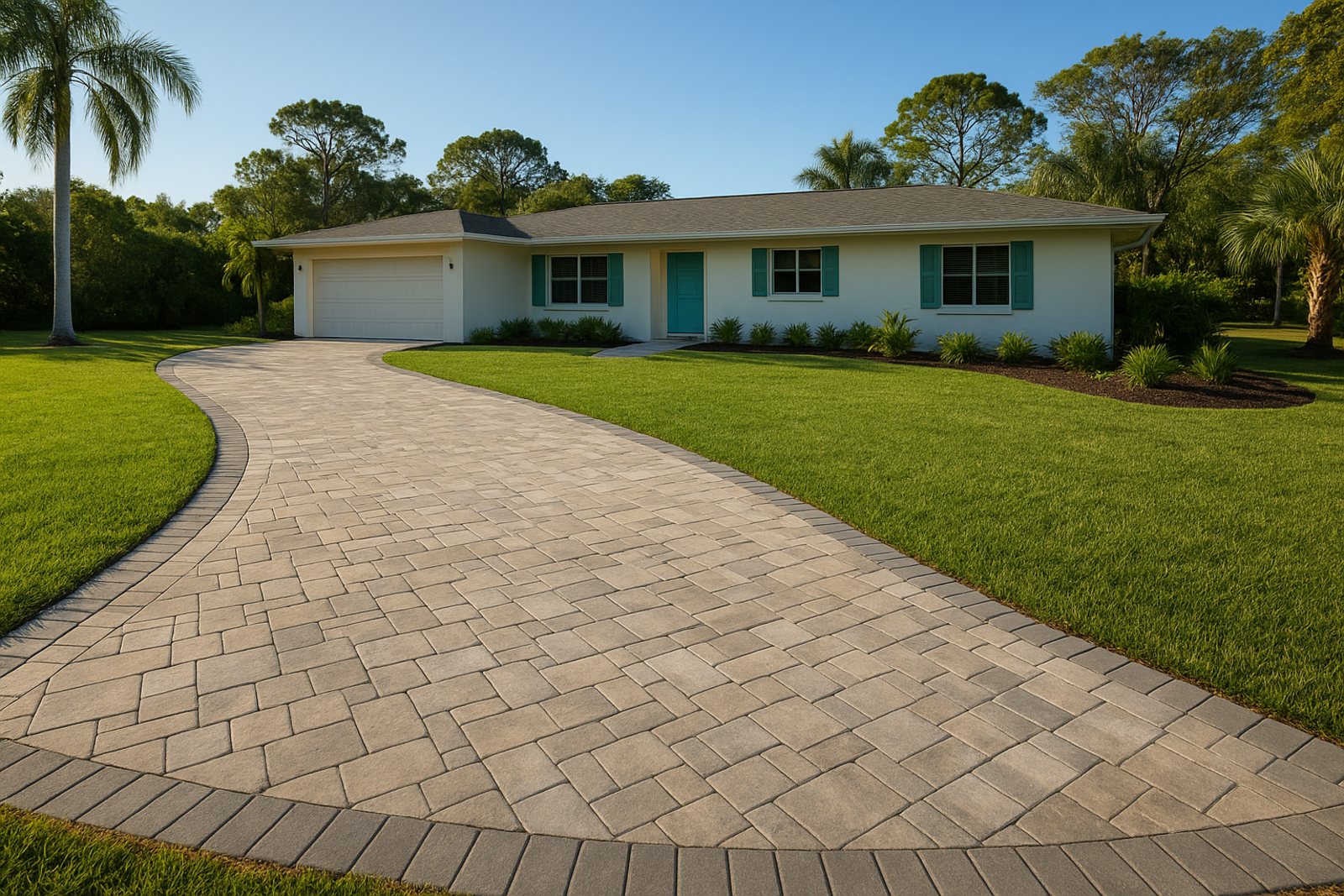
What a Border Does on a Driveway
A border is the row, or rows, of pavers that runs around the outside of the main pattern. First, it looks finished. A herringbone field cut raw against the lawn looks ragged. Instead, a border gives a straight, deliberate line.
Second, it helps the structure. Cut pieces at the edge are smaller and weaker, so a border of full units sits between them and the edge restraint. As a result, the edge holds up better under tires, especially where cars turn in from the street.
Soldier Course vs Sailor Course
These two terms describe which way the border pavers face.
- Soldier course. The pavers stand side by side, with their long side pointing into the driveway. This is the most common driveway border, because it gives a strong, crisp edge.
- Sailor course. The pavers run end to end, with their long side along the edge. It reads as a thinner, lighter line. So it suits narrow walks or a second inner row.
Many designs combine both. For example, a soldier course on the outside and a sailor course just inside it creates a layered frame. In short, a soldier course is the safe starting point, and a sailor row adds detail.
Choosing a Driveway Paver Border Color
Contrasting borders
A darker border around a lighter field is the classic look. For instance, a charcoal frame around a tan or sand-colored field defines the shape from the street. Contrast also hides tire marks along the edges.
Matching or tonal borders
A border in the same color, or one shade off, gives a quieter look. Then the change in laying pattern does the work instead of the color. This suits modern homes and smaller lots.
Tips for picking colors
- Pull a color from your roof, trim or front door.
- Look at samples outside in full sun, because Florida light washes out colors.
- Lay a few border pavers next to the field pavers before you decide.
- Stay within one paver line when you can, so thickness and texture match.
Bands, Inlays and Accents
Borders do not have to stay on the outside. A band is a border-style strip that crosses the driveway. For example, a band can split a long driveway into sections or mark where the walkway meets the drive.
Inlays are small feature areas inside the field. A circle, a square or a diamond in a contrasting color can mark the center of a turnaround. However, keep inlays out of the main wheel paths when you can. Small cut pieces handle turning tires less well than full pavers.
Meanwhile, simple usually wins. One border and one band often look better than several competing accents.
Borders at the Street Apron and the Garage
Two spots need extra thought on every driveway.
Street apron
The apron is where your driveway meets the road. It takes the hardest turning loads. So a strong soldier course here, set tight against a firm edge, is a smart choice. Your contractor should also confirm any local rules for the apron area before work starts.
Garage slab
At the garage, the border meets the concrete slab. A clean soldier row here hides small cuts and gives a neat line. In addition, the pavers should sit at a height that lets water drain away from the garage, not toward it.
To see how these details look on real layouts, browse our driveway borders and aprons page on venicepavers.com.
Edge Restraint Behind the Border
A border is only as strong as what holds it in place. Every paver driveway needs an edge restraint along its open sides. Common options include concrete curbs, a buried concrete bond beam, or heavy-duty plastic or metal edging spiked into the base.
On driveways, many installers prefer a concrete restraint, because tires push hard on the edges. Also, the compacted base should extend past the border, so the restraint sits on solid ground. Otherwise, the border can creep outward and joints open up. The Interlocking Concrete Pavement Institute (ICPI) treats edge restraint as essential for interlocking pavement.
Design Tips Before You Decide
- Scale the border to the drive. A wide driveway can carry a double row. Meanwhile, a narrow one usually looks best with a single soldier course.
- Follow the curves. Borders look best when they flow with the driveway shape. Then the field pattern is cut to meet them.
- Think about the lawn edge. A border sitting slightly above grade keeps mulch and soil off the pavers.
- Plan the walkway link. Carry the same border onto the front walk, so the whole entry reads as one design.
Our driveway design ideas page shows border and pattern combinations. You can also compare paver styles and colors on our paver driveway options page. A well-planned driveway paver border is a small part of the budget, but it shapes how the whole driveway looks from the street.
Why Venice Homeowners Choose Venice Pavers & Landscape
A border is a small detail that shows the quality of the whole job. Venice Pavers & Landscape is a locally owned company with a showroom at 509 Cypress Ave, Suite 1, in Venice, where you can see border colors side by side. We bring 25+ years of hardscape experience, we are licensed and insured, and our own crews cut and set every border course.
We are a manufacturer-certified Tremron installer, and we also install Belgard, Flagstone, TriCircle and Oldcastle pavers. First, we walk your property for free. Then we draw a custom layout and give you a free written, itemized estimate before any work starts. We serve Venice, South Venice, Nokomis, Osprey, Laurel, North Port, Wellen Park, Englewood and Sarasota. To get started, book a free walk-through or call 941-413-1109.
Frequently Asked Questions
Does every paver driveway need a border?
Not always, but most driveways benefit from one. It gives a clean edge and puts full pavers, not small cuts, against the edge restraint.
Should my border be darker than the driveway?
A darker border is the most popular choice, because it defines the shape and hides tire marks. Still, a matching border works well on modern homes.
How wide should a driveway paver border be?
Most borders are a single soldier course. Wider driveways can carry a double row, so it comes down to scale and taste.
Can I add a border to an existing paver driveway?
Often, yes. Of course, it usually means cutting back the field, adjusting the base and setting a new edge restraint, so ask an installer to look first.
Is a sailor course strong enough for a driveway?
It can work, but a soldier course is the more common choice along driveway edges. Therefore, many designs use a sailor row as an inner accent instead.
Related driveway guides
Get Straight Answers About Your Driveway
First, we measure and check drainage. Then we walk you through options, and the estimate is free and in writing.
Get a free estimate 941-413-1109