Driveway Paver Thickness: 60 mm vs 80 mm and What Really Carries the Load
The right driveway paver thickness for most homes is 60 mm (2 3/8 inch), which handles everyday cars and SUVs. Choose 80 mm (3 1/8 inch) for heavier loads such as RVs, boat trailers or work trucks. However, thickness is only one part of the system, because the base, pattern and edges carry the load too.
- Driveway Paver Thickness at a Glance
- Why Patio-Thickness Pavers Are Wrong for Driveways
- 60 mm vs 80 mm: Which One You Need
- What Else Carries the Load
- RVs, Boats and Trucks: Extra Steps
- How to Read a Paver Product Spec
- Putting It Together for Your Driveway
- Why Venice Homeowners Choose Venice Pavers & Landscape
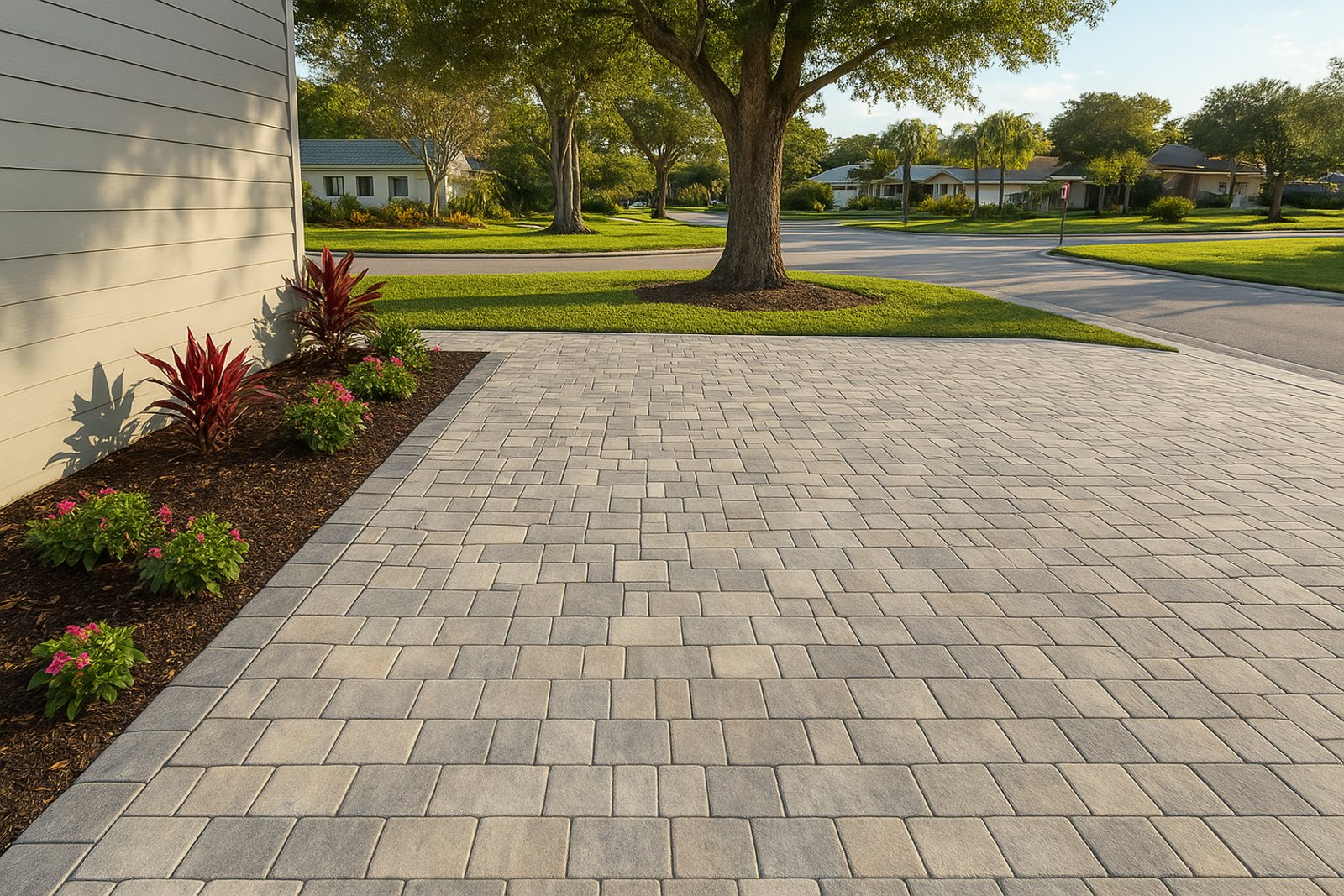
Driveway Paver Thickness at a Glance
First, match thickness to how you use the driveway. Treat it as a starting point, and let your installer confirm it for your site.
| Use | Typical thickness |
|---|---|
| Walkways and patios | Thinner patio pavers, often under 60 mm |
| Cars, SUVs and light pickups | 60 mm (2 3/8 inch) |
| RVs, boats, trailers, work trucks | 80 mm (3 1/8 inch) |
Also, check the manufacturer’s spec sheet, because some products rate their 60 mm units for vehicles and others do not.
Why Patio-Thickness Pavers Are Wrong for Driveways
Makers design patio pavers for foot traffic. So when a car rolls over them, and especially when tires turn in place, thin units can rock, crack or shift out of line. That damage often shows up first near the garage and at the street apron, where drivers turn the wheel.
Some homeowners try to save money by reusing patio stock on a driveway. However, that choice ignores driveway paver thickness entirely. Instead, choose a product the maker rates for vehicular use. The extra thickness gives each paver more resistance to twisting and breaking under a wheel load.
60 mm vs 80 mm: Which One You Need
For most residential driveways in Venice and the surrounding area, 60 mm pavers are the standard choice. That is because they handle daily cars and SUVs well when the crew builds the base correctly.
On the other hand, 80 mm pavers make sense when heavier loads come into play. For example, choose 80 mm if you:
- Park an RV or a motorhome on the driveway.
- Store a boat on a trailer and back it in and out often.
- Have work trucks or delivery trucks on the surface.
- Expect occasional heavy equipment, such as a dumpster drop-off.
If you are on the fence, then ask your installer. The added thickness costs more, so it should match a real need. Our paver cost guide covers what affects pricing.
What Else Carries the Load
Even the right driveway paver thickness will fail on a weak foundation. In fact, the base, the pattern and the edges do much of the work.
Base
The crew places crushed aggregate in lifts and compacts each one. Driveway bases commonly run 6 to 8 inches, or deeper on poor soils, and your contractor should specify the depth. Then a bedding sand layer of about 1 inch goes on top.
Pattern
Herringbone, laid at 45 or 90 degrees, interlocks best under turning tires. Running bond and basket weave look great. Still, they resist turning forces less.
Edge restraint and joint sand
Edge restraint, for instance, stops the field from spreading. Meanwhile, joint sand locks pavers together so they share the load.
RVs, Boats and Trucks: Extra Steps
Heavier vehicles need more than thicker pavers. First, ask your contractor about a deeper or stronger base under the parking area. Then choose a herringbone pattern for any spot where wheels turn. Finally, plan wide, straight approaches so trailers do not cut sharp angles across the field.
Southwest Florida soil adds its own challenge. Our sandy ground drains well. However, heavy summer rain can move fine material if edges are weak. So good edge restraint and full joint sand matter even more on a driveway that carries a boat or RV.
How to Read a Paver Product Spec
Spec sheets can look technical. In fact, you only need a few lines. Look for these items before you choose a product:
- Thickness: listed in mm or inches, for example 60 mm or 80 mm.
- Intended use: look for “vehicular” or “driveway” ratings.
- Standard: concrete pavers in the U.S. often reference ASTM C936.
- Recommended patterns: some shapes suit vehicles better than others.
- Installation notes: base, bedding and joint sand guidance.
Also, the Interlocking Concrete Pavement Institute (ICPI) publishes background on these terms. You can also compare the lines we install on our paver brands page on venicepavers.com.
Putting It Together for Your Driveway
In short, start with how you use the driveway, then pick the thickness, then confirm the base and pattern. That way, every part of the system supports the others. For most families, 60 mm pavers on a well-built base will serve for years.
To see colors and shapes in both thicknesses, visit our paver driveway options page. Then read our driveway installation guide to see how the crew builds the base and lays the pavers.
Why Venice Homeowners Choose Venice Pavers & Landscape
Venice Pavers & Landscape is a locally owned company with a showroom at 509 Cypress Ave, Suite 1, in Venice. We bring 25+ years of hardscape experience, we are licensed and insured, and our own crews do every job. We are also a manufacturer-certified Tremron installer. In addition, we install Belgard, Flagstone, TriCircle and Oldcastle pavers, so we can match the right product to your loads. Every project starts with a free on-site walk-through, a custom layout and a free written, itemized estimate. We serve Venice, South Venice, Nokomis, Osprey, Laurel, North Port, Wellen Park, Englewood and Sarasota. To get the right fit, book a free walk-through or call 941-413-1109.
Frequently Asked Questions
Is 60 mm thick enough for a driveway?
For most residential driveways with cars and SUVs, yes. Choose a product the maker rates for vehicles, and install it on a properly compacted base.
When should I choose 80 mm pavers?
Choose 80 mm if you park an RV, a boat on a trailer or work trucks. It also helps in areas that see frequent heavy loads.
Can I use patio pavers on my driveway?
It is not a good idea, because thin patio pavers can rock, crack or shift under turning tires.
Does driveway paver thickness matter more than the base?
Both matter. Still, the base usually matters more. Even thick pavers will settle or shift if the base is thin or poorly compacted.
Which pattern is strongest for a driveway?
Herringbone at 45 or 90 degrees interlocks best under turning tires. That makes it a common choice for driveways.
Related driveway guides
Get Straight Answers About Your Driveway
First, we measure and check drainage. Then we walk you through options, and the estimate is free and in writing.
Get a free estimate 941-413-1109