Paver Driveway Base Depth: Why the Base Decides How Long It Lasts
A paver driveway base is the compacted layer of crushed stone under the sand and pavers, and it carries every car that parks on top. In most residential driveways it is commonly 6 to 8 inches thick, and deeper on poor soils. Here is why it matters and how to spot a skimped one.
- Why the Base Decides Whether a Driveway Lasts
- The Typical Layers Under a Paver Driveway
- How Deep Should a Paver Driveway Base Be?
- Compaction in Lifts
- Florida Sandy Soil and Drainage
- Signs a Base Was Skimped
- Can You Fix a Weak Base?
- Why Venice Homeowners Choose Venice Pavers & Landscape
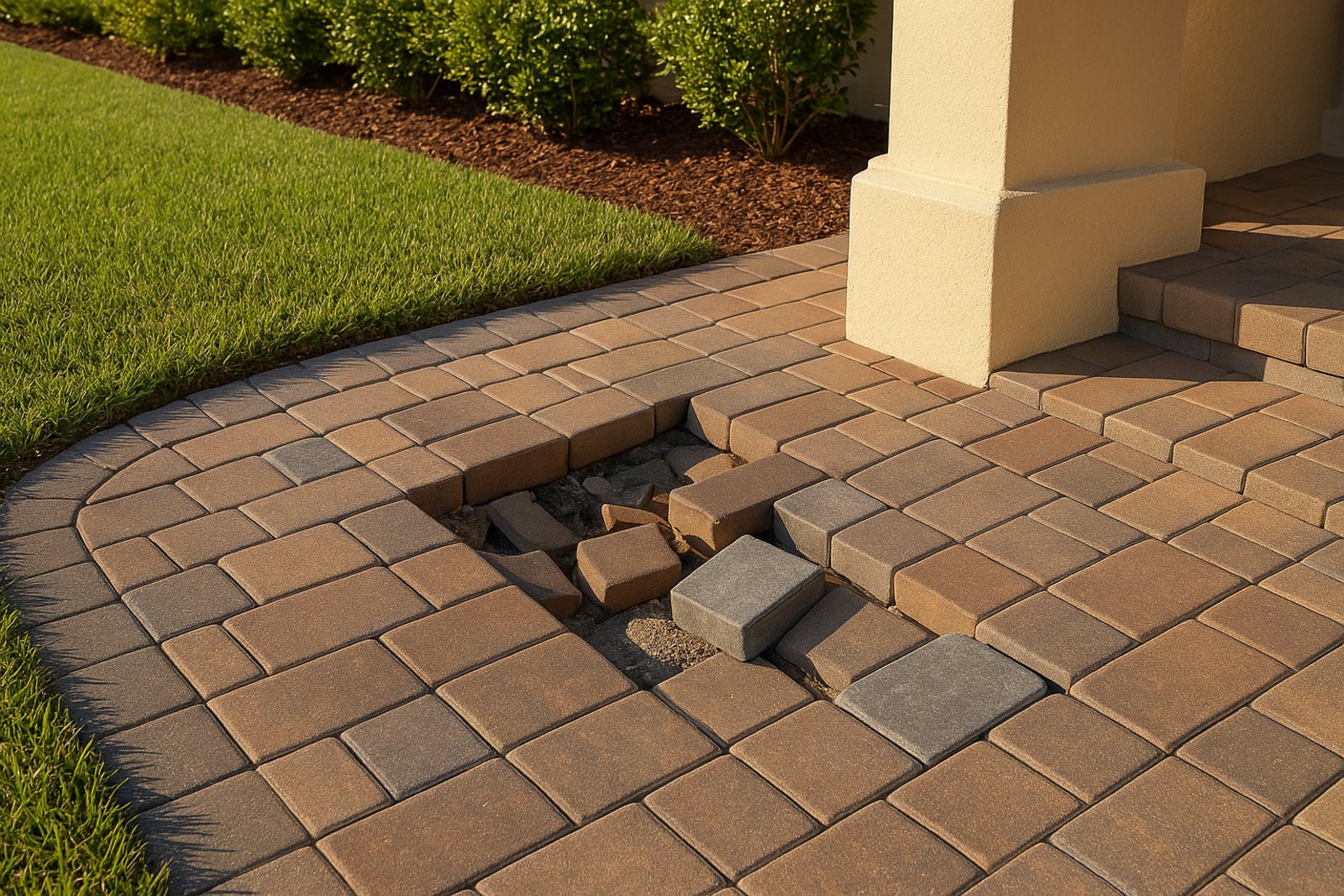
Why the Base Decides Whether a Driveway Lasts
Pavers themselves are tough. In fact, most driveway failures start below them. When a car rolls over a paver, the load spreads down through the bedding sand and into the base. A thick, well-compacted base spreads that load over a wide area, so the soil underneath barely notices. A thin or loose base, however, lets the load punch through to the soil.
The result shows up slowly. First, tire paths start to dip. Then joints open, edges drift and puddles form where water never sat before. In short, the base is the part of the job you cannot fix later without lifting the pavers.
The Typical Layers Under a Paver Driveway
Most interlocking paver driveways follow the same basic build-up. The Interlocking Concrete Pavement Institute (ICPI) publishes guidance on each layer, and careful installers follow it. From the bottom up, the layers usually look like this:
- Subgrade: the native soil, cleared of roots and organic material, then compacted
- Geotextile (when needed): a fabric that keeps soft soil from mixing into the stone
- Base: crushed aggregate, placed and compacted in lifts
- Bedding sand: about one inch of coarse sand, screeded flat
- Pavers: commonly 60 mm (2 3/8 inch) thick for homes, or 80 mm (3 1/8 inch) for heavier loads
- Joint sand and edge restraint: these lock the surface together and hold the edges
Each layer also has a job. So skipping or thinning any one of them puts more strain on the rest.
How Deep Should a Paver Driveway Base Be?
There is no single number for every lot. Still, in most residential driveways the compacted paver driveway base is commonly 6 to 8 inches thick. On soft, wet or clay-rich soils, installers often go deeper. Because cars weigh far more than foot traffic, a driveway base is also deeper than a typical patio base.
Your contractor should look at your soil and drainage, then specify the base depth in writing. That way the number appears on your estimate, and you can check it during excavation. If a bidder will not commit to a depth, treat that as a warning sign. Also note that the excavation goes deeper than the base itself, since bedding sand and pavers sit on top.
Compaction in Lifts
Still, depth alone is not enough. A loose 8-inch base can perform worse than a well-compacted 6-inch one. That is why good crews place the stone in lifts, typically a few inches at a time. Then they run a plate compactor over each lift before adding the next.
A compactor only reaches so far down. So if a crew dumps the full depth at once and compacts the top, the lower stone stays loose. As a result, that loose stone settles later under car traffic. Moisture matters too, of course. For example, slightly damp aggregate packs tighter than bone-dry stone, so crews often mist it as they work.
Florida Sandy Soil and Drainage
Much of Venice and south Sarasota County sits on sandy soil. Sand drains well, which helps. However, loose sand also shifts when water moves through it, and our summer storms move a lot of water. So the subgrade needs compaction just like the base above it.
Then there is drainage, the other half. The finished driveway should slope away from the house and toward the street or a drain. Otherwise, water collects at the garage, soaks the edges and slowly washes out fine material. In addition, downspouts and irrigation that dump on the driveway can soften the base over time. A good plan routes that water away before it reaches the pavers.
Signs a Base Was Skimped
In fact, you can often spot a weak base within a few years. Watch for these signs:
- Ruts or dips in the tire paths
- Pavers that rock or sound hollow underfoot
- Joints that keep opening even after you add sand
- Edge pavers drifting into the lawn or beds
- Puddles that never formed when the driveway was new
- Sinking near the garage, street apron or downspouts
One low spot may come from a single cause, such as a leaking irrigation line. Several of these signs together, though, usually point to a thin or poorly compacted base.
Can You Fix a Weak Base?
Often, yes. Because pavers are individual units, a crew can lift the affected area, rebuild and compact the base, then reset the same pavers. That makes paver repairs far cleaner than patching cracked concrete. Our driveway repair page explains how we handle sinking and shifting areas.
If the whole base is too thin, however, a full rebuild usually makes more sense than repeated patches. You can see how we build a new paver driveway base from the ground up on our driveway installation page. Also, our paver driveway page on venicepavers.com shows finished projects and style options.
Why Venice Homeowners Choose Venice Pavers & Landscape
Venice Pavers & Landscape is locally owned, with a showroom at 509 Cypress Ave, Suite 1, in Venice. We bring 25+ years of hardscape experience, and we are licensed and insured. Our own crews build every base. We are also a manufacturer-certified Tremron installer, and we install Belgard, Flagstone, TriCircle and Oldcastle pavers.
Every job starts with a free on-site walk-through, so we can check your soil, slope and drainage. Then you get a custom layout and a free written, itemized estimate before work starts. Our crews finish most residential paver driveways in a single day once any old concrete is out. To plan yours, book a free walk-through or call 941-413-1109.
Frequently Asked Questions
How thick should the base be under a paver driveway?
In most residential driveways the compacted aggregate base is commonly 6 to 8 inches, and deeper on poor soils. Your contractor should specify the depth for your site in writing.
Is a driveway base deeper than a patio base?
Yes, usually. Cars put far more load on the surface than foot traffic, so driveways need a thicker compacted base.
What material goes into the base?
Most installers use crushed aggregate that packs tight when compacted. Then they add about an inch of bedding sand on top.
Why do pavers sink in only one spot?
A single low spot often comes from water, such as a downspout or leaking irrigation line, or from a soft pocket in the soil. A crew can lift that area, rebuild the base and reset the pavers.
Can I check the base depth during installation?
Yes. Ask the crew to show you the excavation depth and base thickness before they lay the bedding sand.
Related driveway guides
Get Straight Answers About Your Driveway
First, we measure and check drainage. Then we walk you through options, and the estimate is free and in writing.
Get a free estimate 941-413-1109