Permeable Paver Driveway Guide: How It Works and When It Makes Sense
A permeable paver driveway lets rainwater soak through wide joints filled with small stone, then into an open-graded stone base below. As a result, less water runs off into the street. It can suit Southwest Florida well, but it costs more to build and needs different upkeep.
- How Permeable Pavers Work
- Permeable vs Standard Paver Driveways
- When a Permeable Paver Driveway Makes Sense in Florida
- Design Points Your Contractor Should Cover
- Maintenance: Keeping the Joints Open
- Honest Trade-Offs
- Why Venice Homeowners Choose Venice Pavers & Landscape
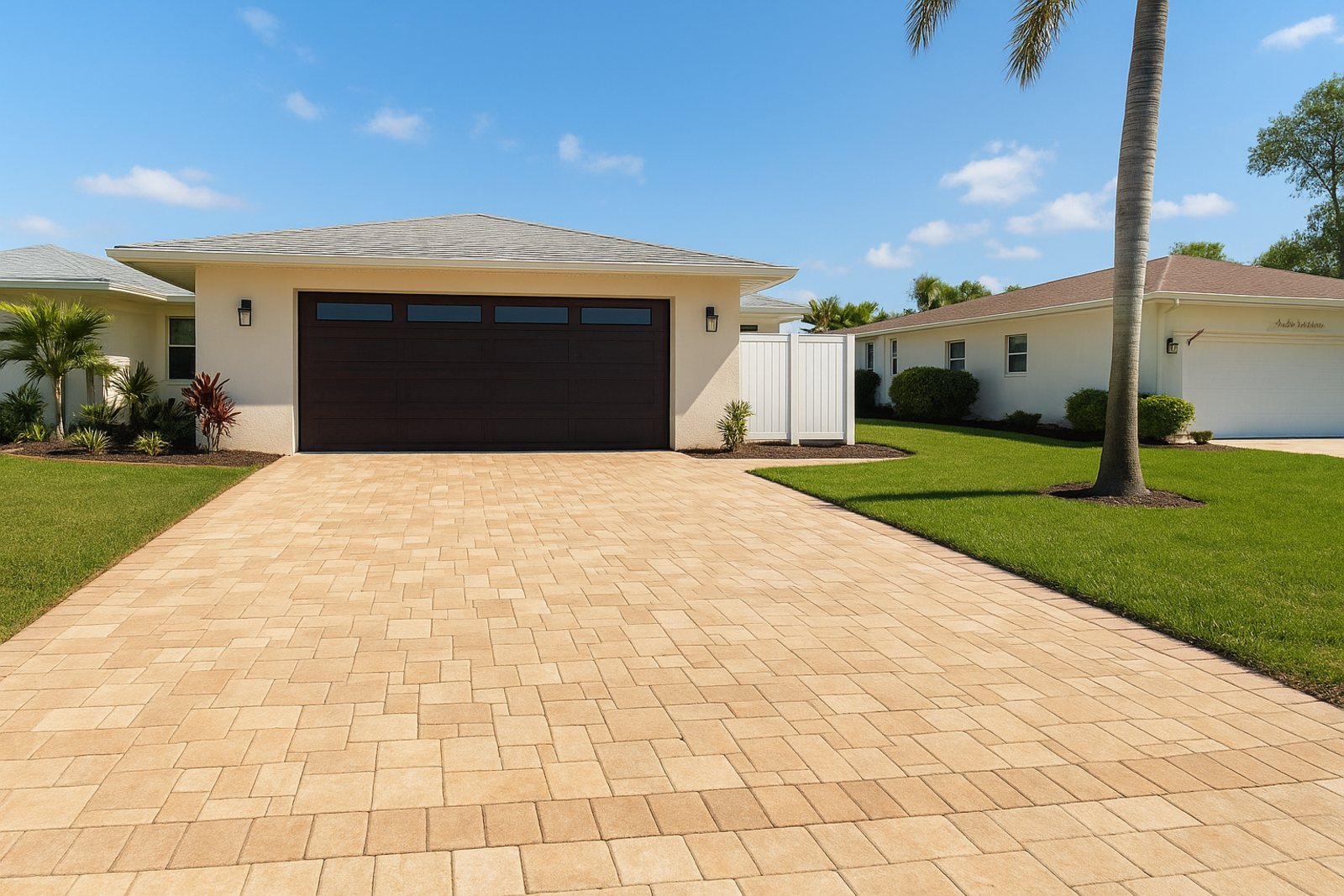
How Permeable Pavers Work
A standard paver driveway sheds water across its surface. Instead, a permeable system lets water drop straight down. It works in three layers, so each one has a job:
- Pavers with wide joints. First, the units have spacer lugs that leave larger gaps than standard pavers.
- Chip stone in the joints. Small, clean crushed stone fills the gaps instead of sand, so water passes through.
- Open-graded stone base. Below the pavers sit layers of clean, washed stone with no fines. That way, the voids between the stones hold water while it soaks into the soil.
In short, the base acts like a shallow storage tank. Then water drains slowly into the ground, or into an underdrain where the soil drains poorly.
Permeable vs Standard Paver Driveways
| Feature | Standard paver driveway | Permeable paver driveway |
|---|---|---|
| Joint fill | Sand, often polymeric | Small chip stone |
| Base | Dense-graded crushed aggregate | Open-graded clean stone |
| Water path | Runs off the surface | Soaks down through the joints |
| Design work | Standard layout | Needs soil and drainage review |
| Upkeep | Sweeping and joint sand top-ups | Vacuuming joints and refilling stone |
Both systems still need compaction and a firm edge restraint. However, the base materials and the design steps differ, so a permeable driveway is not just a standard one with gaps.
When a Permeable Paver Driveway Makes Sense in Florida
Our sandy soils often drain well, which helps permeable systems. In addition, summer storms drop a lot of rain in a short time. So a driveway that stores and soaks in water can ease puddling and runoff.
Permeable pavers are worth a look when:
- Water ponds on your current driveway or runs toward the garage.
- Runoff from the driveway floods the street or a neighbor’s yard.
- Your lot has little room for swales or other drainage features.
- You want to reduce how much hard surface sheds water off your property.
However, they are not right everywhere. For example, a high water table, heavy clay or a lot that stays wet after rain can limit how well the base drains. Therefore, a site review comes first.
Design Points Your Contractor Should Cover
Of course, a good permeable design starts below ground. Your contractor should specify the base depth, stone sizes and any underdrain for your site. They should also check:
- Soil and water table. The base needs somewhere for water to go, so drainage comes first.
- Paver thickness. Vehicular units are typically 80 mm (3 1/8″) for permeable driveways, though some products differ.
- Edge restraint. Also, a firm concrete restraint keeps the open-graded base and pavers in place.
- Nearby sand and mulch. Loose soil washing onto the surface clogs joints fast, so grading and edging matter.
The Interlocking Concrete Pavement Institute (ICPI) publishes detailed guidance on permeable interlocking concrete pavement. So ask whether your installer follows it.
Maintenance: Keeping the Joints Open
A permeable surface only works while its joints stay open. Over time, sand, leaves and grit settle into the chip stone. As a result, water soaks in more slowly.
- Sweep often. Clear leaves and debris, because they break down in the joints.
- Vacuum the joints. Then, when drainage slows, a vacuum sweeper lifts the top layer of dirty stone.
- Refill with clean chip stone. After that, top the joints back up with the same stone size.
- Watch nearby sources. For instance, keep mulch beds and sandy areas from washing onto the drive.
In fact, a simple test helps. Pour a bucket of water on the surface. If it pools instead of soaking in, the joints need attention.
Honest Trade-Offs
Permeable pavers solve real problems, but they are not a free upgrade. So here is what to weigh:
- Cost. The extra excavation and clean stone usually make them cost more than a standard driveway. Our paver cost page explains what drives the price.
- Upkeep. Joints need vacuuming and refilling over the years, so plan for it.
- Footwear and wheels. Also, wider joints feel slightly different under heels and small wheels.
- Site limits. For example, poor-draining soil may need an underdrain, which adds work.
Still, for the right lot, a permeable paver driveway handles heavy rain in a way a standard drive cannot. You can learn more on our permeable paver driveways page on venicepavers.com. You can also compare it with other choices on our paver driveway options page, or see our driveway installation process.
Why Venice Homeowners Choose Venice Pavers & Landscape
Permeable driveways leave less room for shortcuts, so the installer matters even more. Venice Pavers & Landscape is a locally owned company with a showroom at 509 Cypress Ave, Suite 1, in Venice. We bring 25+ years of hardscape experience, we are licensed and insured, and our own crews build each base layer.
We are a manufacturer-certified Tremron installer, and we also install Belgard, Flagstone, TriCircle and Oldcastle pavers. First, we walk your property for free. Then we draw a custom layout and give you a free written, itemized estimate before any work starts. We serve Venice, South Venice, Nokomis, Osprey, Laurel, North Port, Wellen Park, Englewood and Sarasota. To get started, book a free walk-through or call 941-413-1109.
Frequently Asked Questions
Do permeable pavers work in sandy Florida soil?
Often, yes, because sandy soil usually drains well. However, a high water table or compacted fill can slow drainage, so a site review comes first.
Can I use polymeric sand in permeable paver joints?
No. Instead, permeable systems use small chip stone in the joints, because sand would block the water path.
How often do the joints need vacuuming?
It depends on trees, nearby sand and traffic. Many homeowners check drainage once or twice a year, then vacuum and refill when water starts to pool.
Will a permeable driveway stop all flooding?
No. It stores and soaks in rainwater, but very heavy storms can still exceed what the base holds. Instead, think of it as one part of your site drainage.
Can I drive on permeable pavers like a normal driveway?
Yes. When your contractor designs it for vehicles, with the right base and paver thickness, it handles everyday cars and trucks.
Related driveway guides
Get Straight Answers About Your Driveway
First, we measure and check drainage. Then we walk you through options, and the estimate is free and in writing.
Get a free estimate 941-413-1109