Repair or Replace a Concrete Driveway? How to Judge the Damage
Whether to repair or replace concrete driveway damage depends on what is causing it. Hairline cracks on a stable slab usually need only sealing. However, wide cracks, heaving, sunken sections, trip edges and standing water point to base or drainage problems, so replacement is often the smarter fix.
- The Quick Answer: Repair or Replace Concrete Driveway Damage?
- How to Read the Cracks in Your Driveway
- Heaving, Settling and Trip Edges
- Check the Drainage Before You Decide
- When Patching or Resurfacing Is Enough
- When Replacement Makes More Sense
- Why Replacing With Pavers Solves the Root Problems
- Why Venice Homeowners Choose Venice Pavers & Landscape
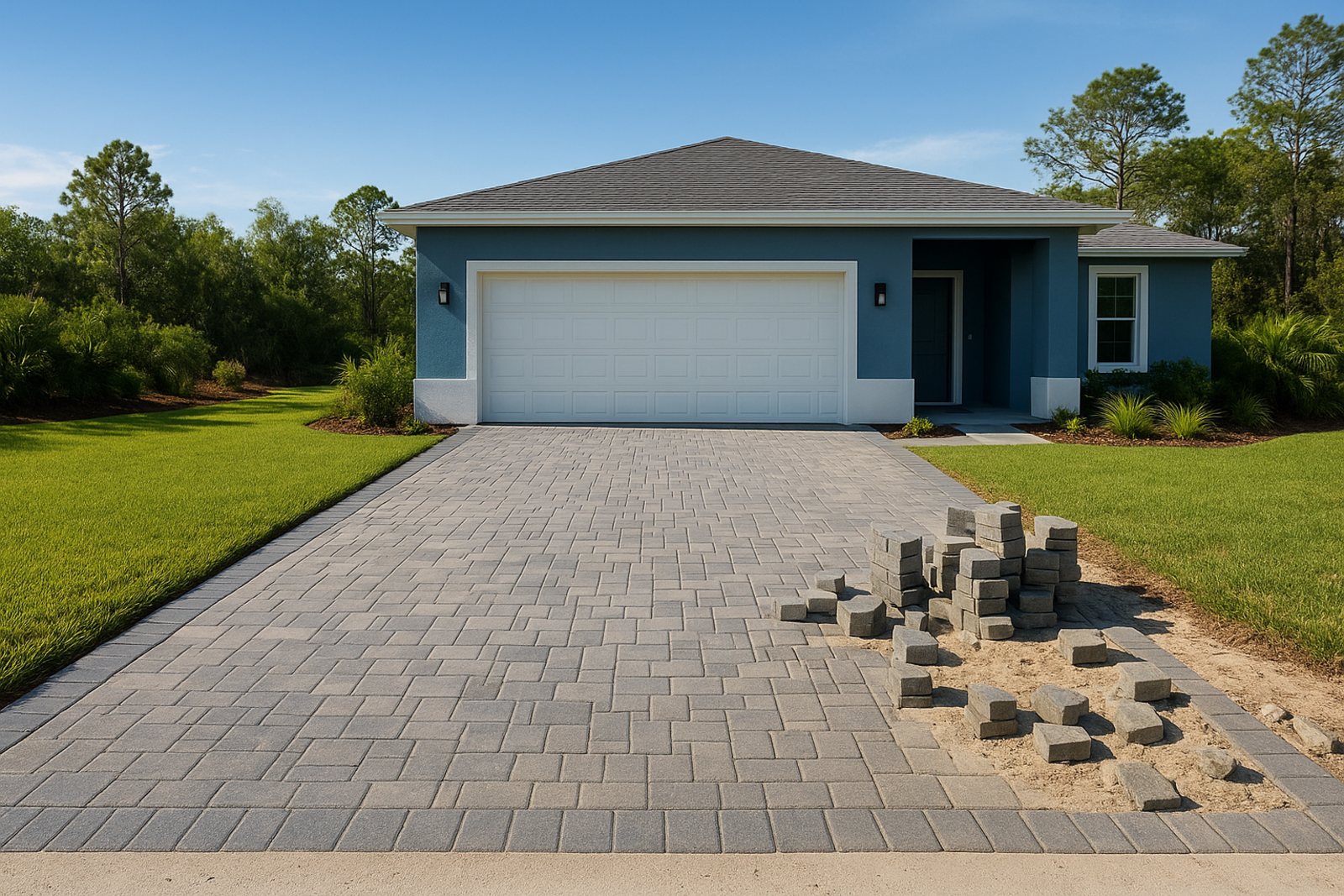
The Quick Answer: Repair or Replace Concrete Driveway Damage?
Start with one question: is the slab still flat and supported? If it is, cosmetic repairs can buy you years. If it is not, patches tend to crack again because the cause sits underneath. Use this short checklist as a first pass:
- Likely repair: a few hairline cracks, surface wear, minor stains, slab still level.
- Likely replace: wide or growing cracks, lifted or sunken sections, trip edges, water pooling against the garage.
- Gray zone: one bad section on an otherwise sound slab, so ask a pro to check the base.
How to Read the Cracks in Your Driveway
Not every crack is a warning sign. In fact, concrete shrinks as it cures, so some cracking is normal, especially near control joints. Instead of counting cracks, look at their width, their edges and whether they are changing.
Hairline cracks
These are thin, roughly the width of a credit card edge, and both sides sit at the same height. They are usually cosmetic. Sealing them keeps water and sand out.
Structural cracks
Watch for cracks you can slip a coin into, cracks that keep growing, and cracks where one side sits higher than the other. These often mean the base has shifted or washed out. As a result, a surface patch rarely lasts.
Heaving, Settling and Trip Edges
Next, look at the slab from a low angle. Heaving happens when something pushes a section up, for example tree roots. Settling is the opposite, because soil or base material below has compacted or washed away. In Southwest Florida, heavy summer rain can carry fine sand out from under a slab over time.
Either way, the result is often a trip edge, where two sections meet at different heights. Trip edges are a safety issue for family and guests. They also tend to get worse, since water collects at the step and keeps working on the base.
Check the Drainage Before You Decide
Drainage problems quietly drive many driveway failures. So after a storm, walk the driveway and note where water sits. Then ask yourself these questions:
- Does water pond against the garage door or the house?
- Do puddles stay for hours after the rain stops?
- Is there erosion or washed-out sand along the edges?
- Do downspouts or irrigation dump water onto the slab?
If you answer yes to several, the slope itself may be wrong. In that case, patching cracks will not solve the problem, because the water keeps coming back to the same spot.
When Patching or Resurfacing Is Enough
Repair makes sense when the slab is sound and level, and the damage is only skin deep. For example, crack sealing, spot patching and cleaning can refresh a driveway with a healthy base. Resurfacing with a thin overlay can also hide wear and stains.
Still, keep your expectations realistic. An overlay follows the slab beneath it, so any crack that moves will usually show through again. For help judging smaller issues, see our driveway repair page. The American Concrete Institute also publishes background on concrete cracking and repair.
When Replacement Makes More Sense
Replacement is usually the better call when several problems show up together. So when you weigh whether to repair or replace concrete driveway slabs, count how many of these you see. Consider it if you see any of the following:
- Wide cracks that have spread across multiple sections.
- Sections that have heaved or sunk, creating trip edges.
- Repeated patches that failed within a few seasons.
- Drainage that sends water toward the house.
- A planned change, such as widening the driveway or adding a parking pad.
In short, if you would be fixing the same slab again in a few years, it is time to compare the cost of ongoing repairs with a new surface. Our paver cost guide explains what affects the price of the paver option.
Why Replacing With Pavers Solves the Root Problems
When you decide to repair or replace concrete driveway sections, replacing with interlocking pavers changes the whole system. First, the crew removes the old slab and rebuilds the base with compacted crushed aggregate. Then they set the slope so water drains away from the house. As a result, you fix the cause, not just the symptom.
Pavers also handle movement better than a solid slab. The joints let the surface flex slightly instead of cracking. Also, if a section ever settles or needs utility access, we can lift and reset those pavers instead of patching. The Interlocking Concrete Pavement Institute (ICPI) covers how these systems work. To see how the switch goes, read our concrete to paver driveway guide and our concrete-to-paver replacement page on venicepavers.com.
Why Venice Homeowners Choose Venice Pavers & Landscape
Venice Pavers & Landscape is a locally owned company with a showroom at 509 Cypress Ave, Suite 1, in Venice. We have 25+ years of hardscape experience, we are licensed and insured, and our own crews do the work. We are also a manufacturer-certified Tremron installer. In addition, we install Belgard, Flagstone, TriCircle and Oldcastle pavers. Most residential paver driveways are done in a single day once the old concrete is out, and you can drive on them in 24 to 48 hours. We serve Venice, South Venice, Nokomis, Osprey, Laurel, North Port, Wellen Park, Englewood and Sarasota. So if you are unsure about your slab, book a free walk-through or call 941-413-1109.
Frequently Asked Questions
Are hairline cracks in a concrete driveway a problem?
Usually not. Hairline cracks on a level slab are often cosmetic, so sealing them is typically enough.
Can I just resurface my cracked driveway?
You can if the slab is level and stable. However, an overlay follows the slab below it, so moving cracks tend to come back through.
How do I know if my driveway base has failed?
Look for sunken or lifted sections, trip edges, and cracks where one side sits higher. Also watch for sand washing out along the edges after heavy rain.
Is it better to repair or replace concrete driveway slabs that keep cracking?
If the same areas keep failing, replacement is usually the better long-term choice. Rebuilding the base and slope addresses the cause instead of the symptom.
How long does a concrete to paver replacement take?
Most residential paver driveways are finished in a single day once the old concrete is out. You can walk on it right away and drive on it in 24 to 48 hours.
Related driveway guides
Get Straight Answers About Your Driveway
First, we measure and check drainage. Then we walk you through options, and the estimate is free and in writing.
Get a free estimate 941-413-1109