You can widen driveway with pavers by adding strips along one or both sides, or a separate parking pad. The keys are a properly compacted base, a clean transition to the existing surface, good drainage and an HOA check first. Done right, the extension looks planned, not patched on.
- Common Ways to Widen a Driveway With Pavers
- Matching or Contrasting With Your Existing Driveway
- Using Borders as Transitions
- Building the Base Under the Extension
- Where New Meets Old
- Drainage and Sprinkler Lines
- HOA Approval and Planning Checklist
- Why Venice Homeowners Choose Venice Pavers & Landscape
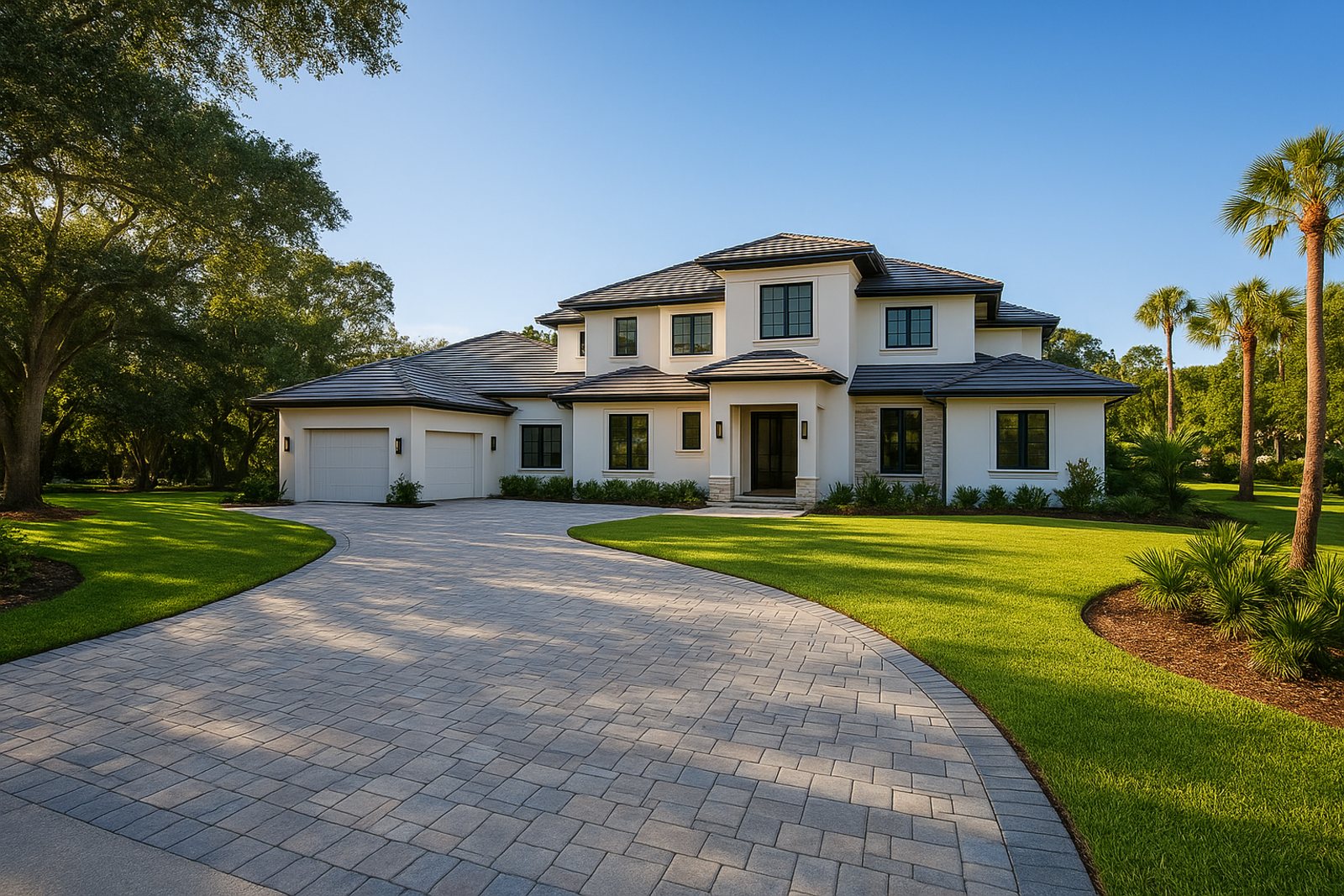
Common Ways to Widen a Driveway With Pavers
Most Venice homeowners want more room for a second car, a boat trailer or simply easier door clearance. So start by deciding what the extra space needs to do. Then pick the layout that fits:
- Side strips: a band of pavers along one or both edges, often 2 to 4 feet wide, to ease getting in and out.
- Parking pad: a full-size space beside the drive for an extra car, golf cart or trailer.
- Flared apron: a wider entry at the street, which makes turning in easier.
- Turnaround: a side bump-out so you can turn and pull out forward, where the lot allows.
Also check setbacks and any utility easements along the side of your lot. Your contractor and local rules will determine how close you can build to the property line.
Matching or Contrasting With Your Existing Driveway
If your current driveway already uses pavers, the simplest plan is to match it. However, colors can vary between production runs, and older pavers may have weathered. So ask to see samples next to your existing drive in daylight before you order.
If your driveway is plain concrete, a perfect match is not possible. Instead, many homeowners choose a deliberate contrast. For example, a charcoal or tan paver strip can frame a gray slab so the whole drive looks designed. For inspiration, browse our Venice driveway design ideas.
Using Borders as Transitions
A border is the easiest way to make new work blend with old. A soldier course or sailor course of pavers along the seam hides small color differences and gives the eye a clean line. Similarly, a border around the full outer edge ties the original drive and the extension together.
Some homeowners go a step further and replace the old concrete apron or center strip at the same time. That way, the driveway reads as one design. Our paver driveway options for Venice show the shapes, colors and borders that work well together.
Building the Base Under the Extension
The extension carries the same car weight as the main drive, so it needs the same base. A good crew follows these steps:
- First, they excavate to the planned depth and remove roots and organic soil.
- Then they compact the subgrade.
- After that, they place crushed aggregate in lifts and compact each one.
- Next, they screed about an inch of bedding sand and lay the pavers in an interlocking pattern.
- Finally, they install edge restraint, compact the pavers and sweep in joint sand.
Driveway base depth commonly runs 6–8 inches or more on poor soils, and your contractor should specify it. Vehicular pavers are commonly 60 mm thick for homes, and herringbone interlocks best under turning tires. The Interlocking Concrete Pavement Institute (ICPI) publishes detailed guidance on these practices.
Where New Meets Old
The joint between the extension and the existing drive needs attention. When you widen driveway with pavers next to concrete, the slab edge acts as one side of the restraint. So the crew should set the new surface flush with the slab and compact the base tight against it.
If the old slab is cracked or sinking along that edge, fix it first. Otherwise, the seam will keep shifting. In many cases, replacing the whole slab ends up cleaner than patching around a tired one.
Drainage and Sprinkler Lines
More hard surface means more runoff. In Venice summer storms, water that once soaked into the lawn now flows across the new pavers. Therefore, the extension should slope away from the house and toward a lawn area, swale or drain that can take the water. Never send runoff toward a neighbor’s yard or your foundation.
Sprinkler lines often run along the side of the drive. Before digging, the crew should locate heads, pipes and valves, then reroute them. Also call 811 so utilities can mark buried lines. Afterward, aim sprinkler heads away from the pavers, because well water can leave rust stains.
HOA Approval and Planning Checklist
Many Venice-area communities limit driveway width, materials and colors. So check with your HOA before you plan to widen driveway with pavers, and get their decision in writing. Every association sets its own rules, and approval is up to them.
- Measure your vehicles and door swing to set the width you need.
- Then confirm setbacks, easements and HOA rules.
- Also choose a match, a contrast or a border transition.
- Finally, plan drainage and sprinkler changes before any digging starts.
To see finished extensions, visit our paver driveway extensions page on venicepavers.com. For pricing factors, read our paver cost overview.
Why Venice Homeowners Choose Venice Pavers & Landscape
Venice Pavers & Landscape is locally owned, with a showroom at 509 Cypress Ave, Suite 1, in Venice. We bring 25+ years of hardscape experience. Licensed and insured, we use our own crews. As a manufacturer-certified Tremron installer, we install Tremron, Belgard, Flagstone, TriCircle and Oldcastle pavers, so we can help you match or contrast your drive.
First, we measure your lot during a free on-site walk-through. Then we draw a custom layout and give you a free written itemized estimate before work starts. We work for homeowners, HOAs and builders across Venice, South Venice, Nokomis, Osprey, Laurel, North Port, Wellen Park, Englewood and Sarasota. Book your free walk-through or call 941-413-1109.
Frequently Asked Questions
Can I widen a concrete driveway with pavers?
Yes, pavers work well beside an existing concrete slab. A contrasting color or a border usually looks better than trying to match the gray concrete.
How wide should a driveway extension be?
It depends on your vehicles and what you want the space for. Side strips are often 2 to 4 feet, while a parking pad needs room for a full car plus door clearance.
Does a driveway extension need the same base as the main drive?
Yes, because cars will park and turn on it. The extension needs a compacted aggregate base, bedding sand and a solid edge restraint, just like the rest of the driveway.
Do I need HOA approval to add pavers to my driveway?
In many communities, yes. Check with your HOA before you start, because every association sets its own rules.
What happens to my sprinklers?
The crew should locate and reroute any lines and heads in the way. After that, aim the heads away from the pavers to limit rust stains.
Related driveway guides
Get Straight Answers About Your Driveway
First, we measure and check drainage. Then we walk you through options, and the estimate is free and in writing.
Get a free estimate 941-413-1109